








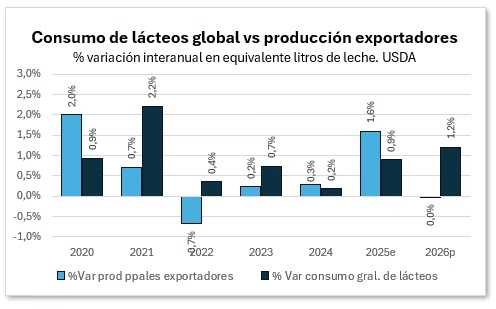
The global dairy industry August 2025 onwards began to experience an excess of volume produced what ended up driving down prices overall. In the graph Dairy consumption, global vs production exporters we can see that in 2025, the production grew more than the consumption. The picture changes to 2026, the year in which it is expected that the production does not present a significant variation year-on-year while consumption will grow by between 1 and 1.5 % which will remove the current pressure on international prices, leaving to see the level of stocks accumulated and the time it takes to demand to absorb them.
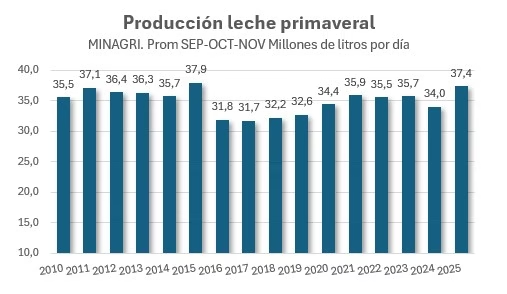
Coinciding with this scenario, milk production in Argentina marked the second highest milk production in its history this spring, only surpassed by that of 2015. This can be seen in the graph Spring Milk Production, which flooded a domestic market with low demand and an external market with falling prices (followed by the graph with the comparative seasonal evolution of the last 4 years): Producción leche primaveral :
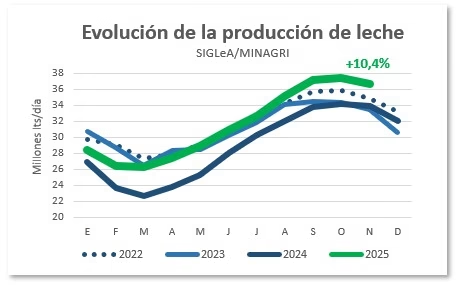
The production starts to sag by seasonality in the last two months of the year, and the year 2025 would end with a volume around +10% in respect of 2024. Already in 2026, the entrance to the summer will involve an additional pressure: the heat stress reducing dry matter intake and, in parallel, the lower forage quality forage, and the greater proportion of cows with long days in milk tend to crop the individual production, as usually happens at this time.
Added to this is the dynamic of the cattle herd: the mass drying off that usually begins in November significantly reduces the number of milking cows, bringing the production stock to its seasonal low around February. A key factor for the first half of 2026 is the corn-to-milk ratio (the kilograms of corn that can be purchased with one liter of milk), which historically averages 2.0 kg/L. Currently, producers are ending the year with 1.8 kg/L, compared to 2.4 kg/L in November 2024, implying a year-on-year decrease in corn purchasing power of approximately 25%. With these relative prices, the start of 2026 would maintain the constraint: unless the producer price approaches $550/L in January, higher volumes are unlikely to be observed during the first half of the year.
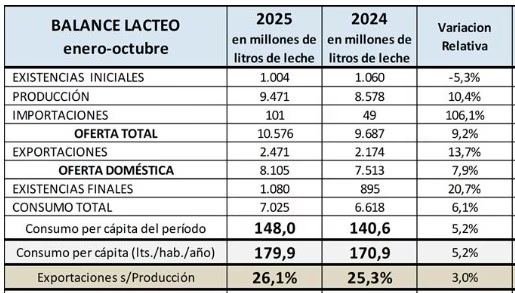
In 2026, the first half of the year will be more closely tied to the domestic market, where seasonal production declines and the evolution of dairy sales will play a role (new economic measures in the pipeline, such as tax reductions, could help). According to OCLA's January-October 2025 Dairy Balance (see chart), per capita consumption grew by 5.2% compared to the same period in 2024, with a moderation observed in September-October due to a greater proportion of promotional purchases. If projections of a 3% real GDP growth are met, and considering an income elasticity of 0.5, per capita consumption could grow by approximately 1.5% in 2026, contingent on disposable income and relative prices.
A realignment of the international landscape is expected in the second half of the year. Slower production and persistent demand are bullish factors that will depend on the level of accumulated inventories.
A likely scenario, from our point of view.
