







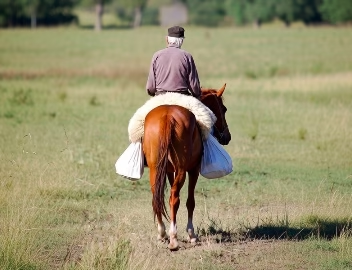
I was on my way to the estancia San Luis in Las Marianas, Navarro, entering the town on the path ex-200, was when I observe on my right hand, a scene that was for the memory that was put together by yourself.
Era una mañana fresca de otoño y cruzando el boulevard de la Shell a un costado del camino, junto a un boliche de campo de esos donde todavía se compra lo necesario y se conversa lo importante, vi a dos paisanos detenidos en una charla corta, de esas que no pierden tiempo pero tampoco apuran. Uno, de gorra y pelo blanco, sostenía dos bolsas de nylon como quien viene de hacer un mandado simple. El otro, con sombrero negro y chaleco, estaba junto a una yegua ensillada, quieta como si estuviera escuchando.
I moved ahead a bit and stopped without thinking, because a scene like that doesn't happen again. I took out my camera and, using the zoom, was able to join the conversation without being seen. I took the photo somewhat timidly—what they call a candid shot—but it was essential that the locals continue without feeling watched.
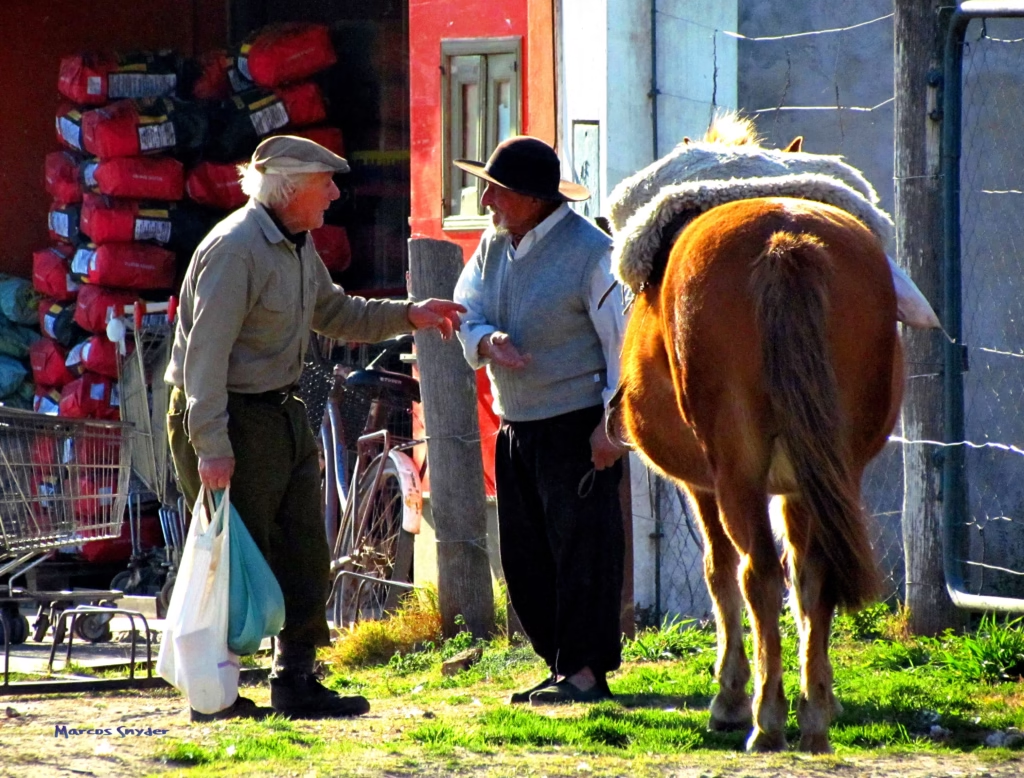
Later I knew the names. The owner of the mare was Samuel Caraballo, muy conocido en Navarro, payador en La Protegida. Tenía 83 years when I took the photo. And the mare was named Pipina. El de la gorra era Joseph.
I didn't hear the words, but in the countryside as in the city, the body speaks. Samuel was serene, with the demeanor of someone who resolves things without arrogance. Joseph had a touch of resistance: the dignity of those who prefer to handle things on their own, even if it's not always the best course of action.
And there, without the need for theatre, appeared the gesture. Samuel pointed the horse as if it provided for a mate.
—Jump on —said, or what his gesture said.
Joseph did as expected: denied first.
—No, Samuel… forget it. Don't worry. I'm walking.
Samuel did not discuss it with big words. He insisted with logic, how one insists in the country.
—Walking? And what is Pipina here for?
Joseph sought the output of the pride:
—I don't want to bother you.
Samuel looked at him without harshly, but firmly. As those who put a thing in its place.
—This does not bother. This is a gauchada.
The word fell simply, without emphasis. And precisely for that reason it carried weight. Because please it sounds to account. Gauchada sounds like code: restrained help, no invoice, no humiliation, no speech.
—Come on —insisted Samuel—. Get on, do what you have to do, and that's it.
Joseph still defended himself, more out of form than conviction:
—And how are you getting back, Samuel?
Samuel nodded backwards, as if the answer had always been there.
—We're neighbors, you know. Pipina returns alone along the dirt road. .the neighborhood. Grabs the trail and head home guided by her memory.
And he added, with the naturalness of someone whose world is ordered by relationships:
—And a relative is waiting for me. I came to see him. He's coming back in the truck and giving me a ride. You go ahead and relax.
That completely dismantled any excuses. Because the person who receives a favor also needs one thing: that the help doesn't leave them with a burden of guilt. Samuel, with two sentences, lifted that weight off his shoulders.
José approached Pipina with the gentle awkwardness of age. Samuel didn't try to be a hero: he adjusted a strap, tweaked a detail of the saddlebag, as if doing the most ordinary thing in the world. Pipina waited quietly, patiently, ready to be the solution.
"Take it easy," Samuel told him. "And if you run into anyone, say hello. Don't go around acting like you're at odds with the world."
Joseph smiled for the first time, defeated in the best sense:
—You always giving orders...
Samuel answered dry, without drama:
—They're not orders. They're shortcuts.
Joseph mounted. Pipina took a couple of steps and the scene began to unravel, which is how real things unravel: without ceremony. Before leaving, Joseph turned around.
—Thank You, Samuel.
And Samuel, as if he were embarrassed to be thanked for what for him was a basic human obligation, waved his hand in the air:
—Just leave!.
I put the camera away and continued my journey. Much later I learned that they were both gone. And the photo became something else for me: not a pretty picture, but a testament to a way of life that makes no noise, but sustains entire communities.
Because in the end of the day, a good deed is just that: helping someone get where they need to be. Without keeping score. Without showing off. With a simple gesture: offering what you have on hand—even if it's just a saddled mare by the side of the road—and making it work, without making the other person feel inadequate.
Samuel Caraballo, 83 years old and with Pipina ready, was not "making history." He was doing what he always did.
And perhaps that's why the scene forced me to stop.
Not because of the photo, but because of the code.
buen dia Marcos , quiero agradecerte por la gauchada , EXELENTE !!!!!!!!!.
ojala mucha gente como vos retrate y escriba tan sencillo pero a la vez tan sentido y descriptivo .
estas cosas del campo tenemos la suerte de verlas gente como vos y yo , que trabajo para Provimi como tecnico en crianza . Tambien voy a San Luis y a Santa Teresa
GRACIAS !!!!!!!!!!!!!!!!
Qué lindo momento Marcos querido.
Y qué bien lo describís e ilustrás.
Esos valores que gracias a Dios todavía podemos ver, compartir, y disfrutar.
Muchas gracias.