





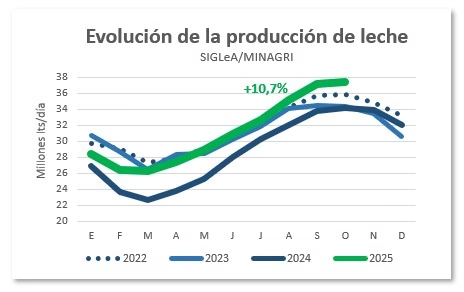
After a contraction in 2024, the Argentine dairy sector entered spring 2025 with full throttle. Between January and October, production grew by 10.7% year-on-year, leading the global increase among major dairy-producing countries.
October saw a cumulative production of 37.5 million liters per day, setting the second-highest daily figure after the 38.5 million liters per day recorded in October 2015.
The problem is that this "production revival" ran up against a limited domestic market and an industry that, despite strong exports, began accumulating stocks. In September, dairy stocks reached 990 million liters equivalent, 14% higher than the previous year. The key question for producers and industry is whether the combination of lower production expected from November onward, the export growth (+13% vs. 2024), and increased consumption (+7%) will be enough to ease market pressure by January and February, or whether the milk surplus will last longer than anticipated. . . . .
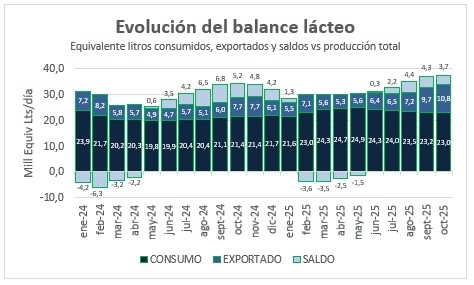
In the following chart we analyze the evolution of the balance dairy monthly , calculating the monthly balance generated by subtracting domestic consumption and exports from national production. We observe a positive balance that is being transferred to stocks. It is noteworthy that the balances are lower than those recorded last spring. ..
Looking more closely at the months of October 2024 and October 2025, we observe that in October 2025 we have +3.2 million liters with fewer "possible outlets" because, although this spring (Aug-Oct) the prices of whole milk powder were +8% over those of spring (Aug-Oct) 2024 (Avg. 3,991 vs 3,705 US$/ton LPE), and mozzarella -2% (Avg. 4,392 vs 4,515 US$/ton MOZZA) we are already at the ceiling of export capacity (≈10 million L/day net)... forcing the balances to go into stocks.de 15-18 millones de litros bajamos a 10 mill lt/día netos por hibridar con el secado de suero). obligando a que los saldos pasen a stocks.
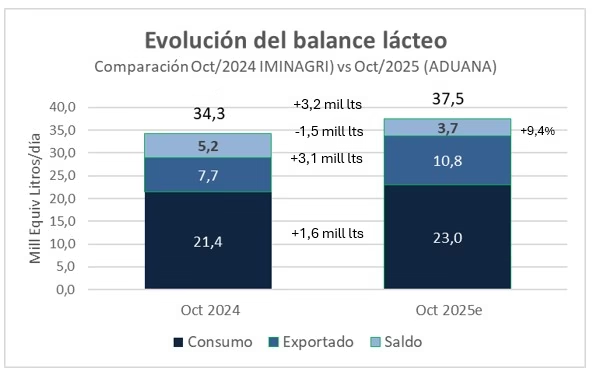
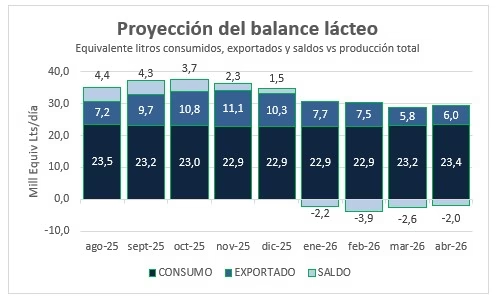
In summary: in October 2025, there is more milk, with export capacity to the limit, +8% better price for the SBA export and mozzarella -2% below and domestic demand weak, por eso la ola de leche pega mucho más fuerte y empeora la situación de toda la cadena respecto de octubre 2024. En el gráfico que sigue realizamos una proyección del Balance Lácteo para los próximos meses considerando que la producción seguirá copiando la estacionalidad del año 2021 como hasta ahora y que a partir del 2026 tendría el volumen similar (tal vez menor al del 2025 en primer cuatrimestre debido al deterioro de -23% en la relación maíz/leche). El consumo se mantendría igual en enero y febrero 2026 con ligera mejora en marzo y abril. Estimamos una baja en las exportaciones debido a los márgenes más ajustados y menos leche excedente. Con estos considerandos veríamos que los saldos positivos continuarían hasta diciembre, y a partir de enero 2026 serían negativos como es habitual para este período del año. Hay que seguir mirando con atención la evolución de la producción pues hay muchas variables en juego. Lo que sí queda claro es que de no ampliar la capacidad de exportar arriba de esos 10 millones de litros de leche diarios…cada ola generosa de leche nos hará tambalear…seguramente la industria exportadora, y el resto también, deberá pagar por sólidos!

Muy buena nota Marcos, gracias, saludos